Congrats to Castoe lab PhD student Yannick Francioli (lead author) and other coauthors for their recent paper in Nature Communications! This paper provides exciting new approaches for studying the process of speciation at genome-wise scales by applying genomic coupling theory to empirical data, enabling quantitative evidence for genome-wide associations that lead to the buildup of reproductive isolation.
- Francioli, Y.Z., J.M. Bernstein, R.H. Adams, H.D. Guss, D.R. Schield, S.N. Smith, S.S. Gopalan, D.W. Magg, J.M. Meik, T. Jezkova, J.P. Demuth, R.W. Clark, S.P. Mackessy, Z. Gompert, and T.A. Castoe. 2025. Estimation of genome-wide coupling in rattlesnake hybrids provides insight into the process of speciation and its progress. Nature Communications 16: 10242. PDF
Summary:
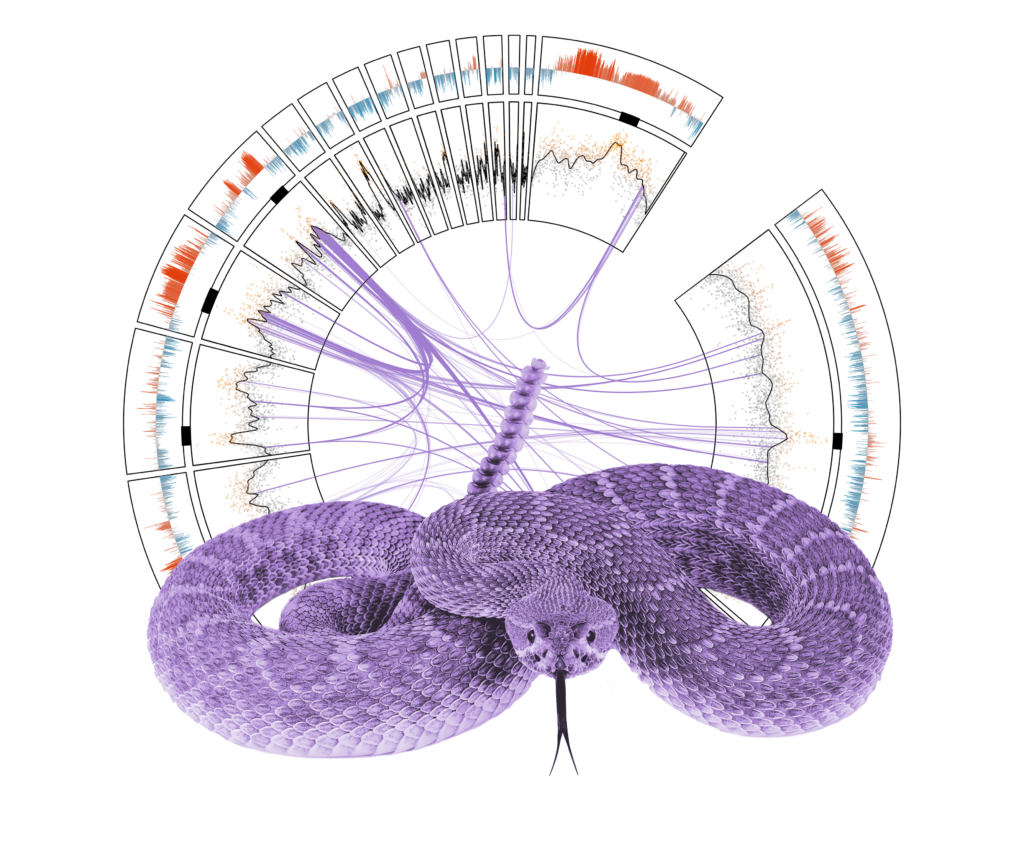
Genomic coupling theory predicts that progress towards speciation involves a transition from the dominant effects of selection on individual barrier loci to the aggregate effects of direct and indirect selection across loci that collectively produce stronger barriers to gene flow through genetic associations. However, our ability to test this prediction and to understand the factors that lead to the buildup and maintenance of these associations has been limited by a lack of methods to estimate variation in coupling across the genome. Here we develop approaches to quantify coupling using window-based estimates of Barton’s coupling coefficient and apply these to a dataset of 118 genomes from a rattlesnake hybrid zone. Our results provide empirical evidence for genomic coupling that is consistent with the predicted relationships of coupling with recombination, linkage, and inferences of selection. Applying these approaches, we find evidence for coupling within and among chromosomes, and highlight the roles of coupling in complex barrier effects, including the Large-Z effect, cytonuclear incompatibilities, and incompatibilities related to venom resistance. Together, our findings demonstrate the mechanism by which coupling is predicted to lead to speciation, and highlight how genome-wide quantification of coupling presents a promising framework for understanding progress towards speciation and the processes that underlie this progress.